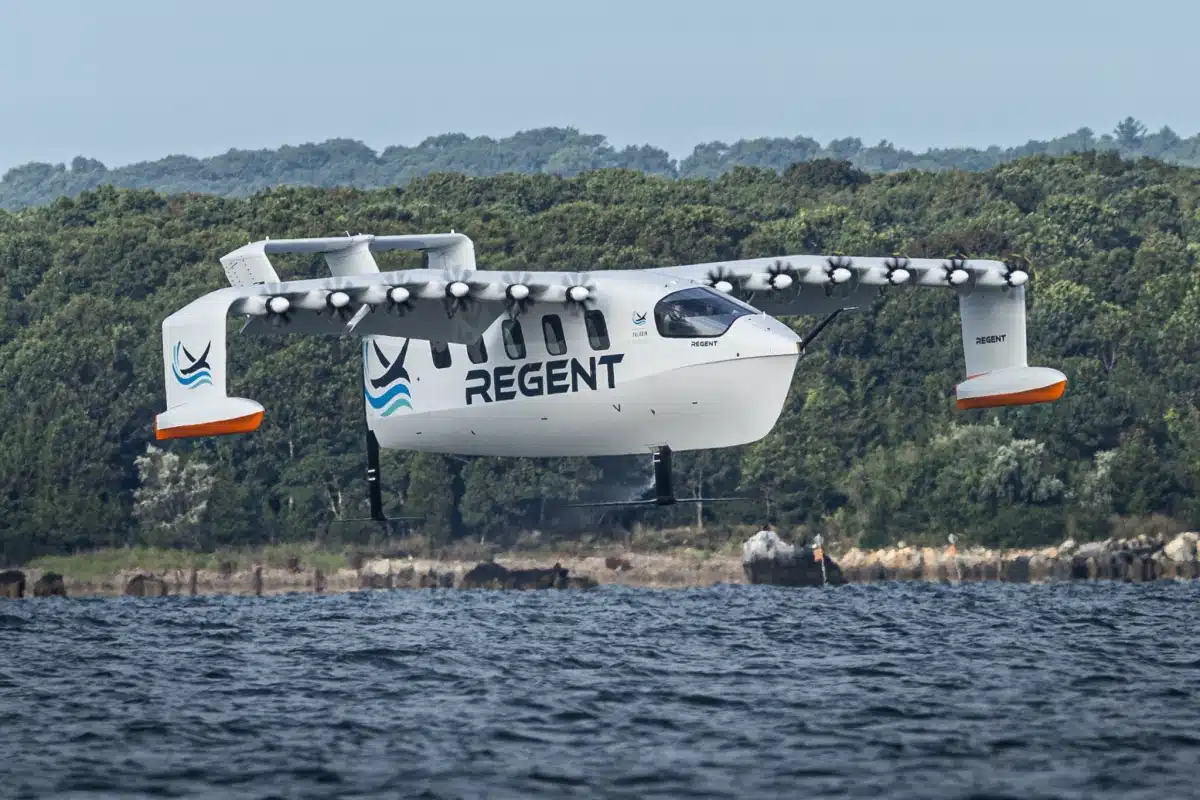
596 meters in thirty seconds, ten meters above the water. The number matters less than what it represents: the first time a human being has flown aboard thealliances Regent's electric boat. The Rhode Island company has combined hull, hydrofoil, and wings into a single vessel, designed to connect shores without airports. It's called Viceroy. On September 2, 2026, in Narragansett Bay, it ceased to be a floating prototype.
Two pilots on board, a tripled fly-by-wire system to manage pitch and roll. A flight of 1.956 feet (596 meters) at 33 feet (10 meters) above the ground. Small numbers, if considered as records. But Regent He wasn't looking for amazement: he was validating the fundamentals of a design that blends three modes of movement in a single hull.
How the glider that is also a boat works
At low speed, the Viceroy behaves like any other boat, its hull in the water. As it speeds up, the hydrofoils lift it out of the wave, reducing drag. Then theground effect: a cushion of air between the wings and the surface that supports the vehicle with a much lower energy consumption than traditional flight.
The physical principle is not new. ekranoplans The Soviets were already exploiting it in the 70s: military monsters, difficult to maneuver, capable of flying only on flat seas. The Viceroy takes the same effect and makes it manageable. Hydrofoils provide tolerance to rough seas and the maneuverability needed near ports, where historic ekranoplans could not safely approach.
Who drives it (and who regulates it)
Here comes the detail that complicates the "aircraft of the future" narrative. The Viceroy is classified as a vessel, not an aircraft. It will be regulated by the U.S. Coast Guard, not the FAA. The pilots are maritime captains with a special qualification, not airline pilots. The vehicle closest to a private jet that we will see in the coming years will never pass through an airport or an aviation authority: maritime regulatory timeframes, historically, are much more streamlined.
Two days before the flight, Regent closed a €220 million Series B round. Commercial deliveries are expected in 2027. Operational range: 160 nautical miles (296 kilometers) with current batteries, with a promise of exceeding 400 with the next generation.
The Viceroy in numbers
First manned flightSeptember 2, 2026, Narragansett Bay, Rhode Island. 596 meters traveled at 10 meters, 30 seconds duration, two pilots on board. Specifications: 12 passengers, top speed 290 km/h, range 296 km. Financing: €220 million Series B round closed on August 31, 2026. Source: REGENCY CRAFT.
In March 2025 we had the Viceroy told While it passed the first tests in hydrofoil mode, the hull still anchored to the water. A year and a half later, the same prototype broke away from the surface with people on board. For a scale comparison, the NASA tested an eVTOL air taxi As early as 2021, but the FAA certification process is slow. The Viceroy, bypassing conventional civil aviation, could arrive sooner.
How long until a real ticket
Thirty seconds of flight doesn't make a commercial service. Higher cruising speeds and worse weather conditions still need to be validated before deliveries in 2027. The regulatory framework, though lighter than the aviation one, is still being finalized. Meanwhile, Regent is also testing Squire, a smaller, unmanned version for military applications: a clue as to who, between paying passengers and the Pentagon, might board first.
When will we see it operational?
Estimated horizon: 1-3 years (short).
The final stages of the sea trials remain to be completed and the Coast Guard's final approval obtained. The first to benefit will be the short coastal routes between islands and the mainland, where a ferry takes hours and a plane has no runway to land on. The cost of the ticket, for now, remains the biggest unknown.
Thirty seconds isn't a flight. It's proof that, for the first time in half a century, someone has pulled a decent glider out of the ekranoplan drawer and made it civilian.


