
23 grams, this is the weight of the prototype of glasses that a group from the Beijing Institute of Technology has just published on Science Advances, and which brings infrared vision out of the ghetto of monochrome green. With this device, weak signals turn red, strong ones turn blue, and everything else in between is a continuous palette of purple and magenta.
This is no small change, because color infrared vision will bring information that flat green has been throwing away for fifty years.
The night vision paradigm was born in the 60s and has changed very little since then: A sensor collects infrared light and re-emits it with green phosphors, because green is the color to which the human eye is most sensitive in low-light conditions. What you see is bright, but all the wavelength information—all the differences (for example) between a hot metal and human skin—are compressed into a single green-tinged grayscale. It's physics thrown away at the first pass.
How color infrared vision works
Quantum dots absorb infrared light and, depending on the wavelength, release electrons with different energies. Above is an OLED with two emissive layers, red and blue, with an intermediate barrier calibrated to trap low-energy charges. A weak signal, the barrier holds, and only the red light lights up. A strong signal, the charges overcome the barrier, and the blue light also lights up.
The physics of optics speaks directly to the eye, without software mediation. Another Chinese laboratory has already demonstrated a similar direction, which in December 2025 put 4K infrared imaging inside a smartphone moduleChina, in this supply chain, is moving with a continuity that should give us pause for thought.
A 23-gram pair of glasses that sees in color
The prototype weighs as much as a pair of reading glasses and is semi-transparent, so the wearer sees the normal world with infrared information superimposed, like a second layer of reality. A switch allows for blocking visible light for surveillance scenarios in complete darkness.
The paper presenting these glasses estimates a sensitivity di two orders of magnitude higher to the old monochrome night vision device, and a luminance above 700 cd/m², sufficient for outdoor use in broad daylight. No bulky battery, no cryogenic cooling. The glasses of the MIT that last summer showed color at room temperature They were working on a different principle; Beijing arrived a year later with a more mature package along a different path.
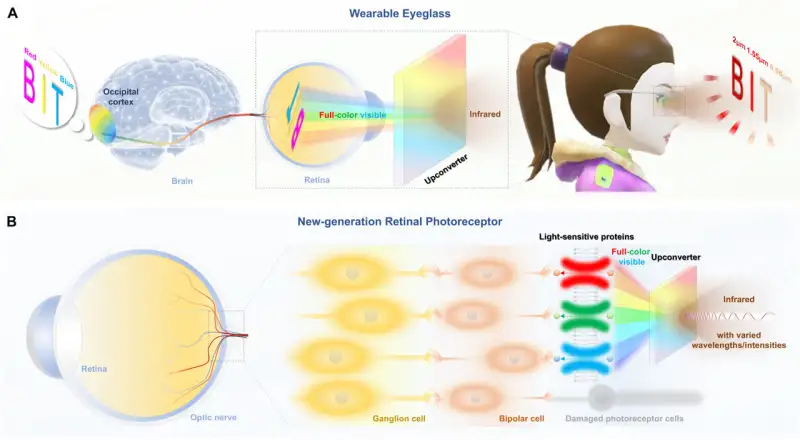
The artificial photoreceptor that no one has yet named
There's a second experiment in the paper that deserves attention. The researchers took retinal cells genetically modified to respond to visible light and exposed them to the output signal from their upconverter. The cells responded. The device therefore works as artificial photoreceptor plausible, not only as glasses.
The connection with the night vision achieved with a retinal injection from six years ago is less risky than it seems: the same physics as upconversion, applied inside the eye instead of in front. Mercury in quantum dots remains a serious regulatory obstacle, and the stability of the double-layer OLED in real-world conditions remains to be verified.
The work published in Science Advances
Publication: Beijing Institute of Technology group, “Multispectral infrared-to-full-color upconversion expanding human vision”, Published on Science Advances (2026). DOI: 10.1126/sciadv.aed0245.
From here to the civilian viewer, the real times
5-10 years for military and industrial applications, 12-15 for civilian consumption, provided that the mercury problem is circumvented with alternative materials already in the research phase.
Who will use it? Rescue workers, forest rangers, and those who work in the dark at ports or in mines.
The military green we saw in war movies for half a century was a shortcut, not an optical choice: the human eye can distinguish millions of shades of color and a few dozen levels of gray, and until now infrared vision had imposed on its users exactly the signal that the brain is worst at handling.
In any case, we still need to figure out the price, the performance in real-world conditions, and who will tackle the mercury before it becomes a serious problem. As they say: we'll see, this time even in the dark.


