Last Sunday, in Rome, John Elkann he said a sentence that should be framed: “A Ferrari has never been defined by what drives it.”He said this while presenting a car that is entirely defined by what moves it. Ferrari Luce It's the first electric car from Maranello, it costs 550.000 euros, and it sent the stock price soaring down by almost 8% within a few hours. Shareholders sometimes read before fans (but come on, the stock price goes up again, I think).
Let's start with the numbers, which are remarkable and no one disputes them. Four electric motors, one per wheel, for 1.050 horses Overall. Zero to one hundred in 2,5 seconds (enough to make you feel like you're sitting on a chair), the top speed is 310 km/h, and the range is over 530 km with a 122 kWh battery mounted in the floor as a structural element.
Shall I continue? An 800-volt platform developed in-house, suspension derived from the F80 hypercar, five full seats, four rear-opening doors, a 600-liter trunk. On paper, in short, a serious machine. Very serious. Like the situation that has arisen.
An iPhone on four wheels
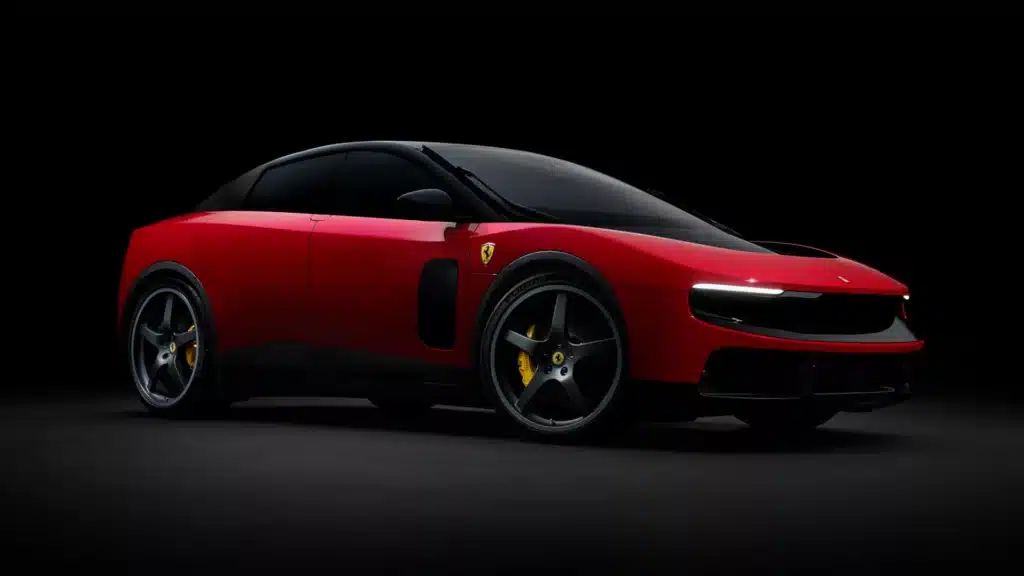
How many times will you hear this joke in the next few days? Come on, I've already done it. The Ferrari Luce design, as you've known for a while, is by Jony Ive, the man who designed the iPhone, through his studio LoveFromAnd it took five long years of work. The result is a sedan with smooth surfaces, a full Corning glass roof (yes, the same one used on smartphones), soft proportions, and a pale blue launch palette that reminded some people (not me, eh?) of the iPhone 5c.
From above, someone wrote, it looks like a parked phone. An AIR Capital analyst, in a note to investors, described it as a cross between an electric Honda Accord and a Tesla Model 3. On Reddit, it fared worse: “it looks like a Nissan“, “it looks like Waymo”, “they've completely lost their minds”.
Ferrari's chief designer, Flavio manzoni, acknowledged that the line is “polarizing”, and he promised that we'll learn to appreciate it over time. Okay. That's exactly what everyone says when the first reaction is a grimace.
The issue isn't taste, which is subjective and transient. The issue is what it means for a Ferrari to be validated by Cupertino to exist. Historically, all Ferraris were designed (inside and out) in Maranello, and you could recognize them from across the street without seeing the symbol on the hood. You can recognize this one by the symbol: remove it (as Luca Cordero di Montezemolo hopes in a statement today) and it could emerge from a dozen or so concept designs from design studios, all named with a single word and a thin font (this one's for those who do my job).

The Sound That Isn't There (and the Accelerometer That Invents It)
Then there's the issue of noise, which is the most melancholically honest part of the entire project. A Ferrari has always been, above all else, about sound: the revving V12 is half the legend. The Ferrari Luce, of course, is electric, so by default it should be silent.
Maranello's solution? A precision accelerometer placed in the heart of the axle captures the real mechanical vibrations of the powertrain and amplifies them in the passenger compartment, “How do you amplify an electric guitar compared to an acoustic one?”, they explained. It's not a fake recorded rumble, they're keen to point out: it's a real vibration, captured by a sensor and reintroduced stronger. The distinction is subtle. The fact remains that the acoustic emotion of a Ferrari, here, passes through a transducer.
Let's say that the horse doesn't neigh in our ears, but we hear it through headphones.
And a heavy horse, too. The Ferrari Luce is on 2.260 kgIt's the heaviest car ever to leave Maranello, and by quite a bit. To put this into perspective, a 296 GTB weighs in at under 1.500 kg dry. More than seven hundred kilos of difference, which is like having a small utility car hidden in the floor. You can make a lightweight electric car, sure, but a 122 kWh battery pack weighs what it weighs, and physics doesn't read press releases. A car that makes agility a religion starts with a good 1.5 quintals of weight handicap compared to its combustion-engined sibling. They hide it well, with the architecture and electronics derived from the F80, but the weight is there.

Ferrari Luce: Are those who turn up their noses at it wrong?
Elkann insisted that the Ferrari Luce “It's not a response to change, it's a decision, a deliberate decision.”The point is that deliberate decisions, when they look like this, look a lot like responses. Porsche e Lamborghini They just put the brakes on electric cars, citing weak demand; Ferrari is stepping up the pace, and doing so with a model that appeals to a new customer base (younger, more tech-savvy, and less enamoured with twelve-cylinder engines), while the existing ones, meanwhile, will continue to buy combustion engines, which remain on the market and generate better margins.
The Ferrari Luce doesn't replace anything. It's an addition. It's a positioning experiment, costing €550.000 a pop, and Ferrari will still sell a few thousand to people for whom price is a consideration.
All legitimate, let's be clear. Every Ferrari innovation has made purists turn up their noses: the mid-engine, the turbo, the paddle-shift gearbox, the hybrid of the SF90. Each time, the faithful have cried betrayal, and often they were wrong.
Maybe it will happen again. Only this time, it's not a single component that has changed: it's who's holding the pencil and where they're looking at the world from that has changed. Apple Car which Cupertino never managed to build, in the end, was designed by the man from Cupertino. Only it says Ferrari on the front.
When will we really see it?
Estimated horizon: deliveries in Europe from the fourth quarter of 2026, in the United States from the second quarter of 2027.
The real verdict does not come at the launch nor from the reactions on X: it will come in two or three years, when we will see if these customers remain loyal to a brand that they have chosen for reasons opposite to those of the old ones. Jony Ive's touch It doesn't guarantee success: anyone who remembers how the last Apple device built on the same philosophy ended up knowing this well.
In Maranello, for eighty years, they built something else. There was a gentleman who designed them by hand and called them "my creatures": now there's a studio in San Francisco and an accelerometer in the axle that acts as the engine.
“But is it a real Ferrari?” I asked at the bar this morning. “It makes 1.050 horsepower and costs half a million,” a colleague replied. Fine. I hadn't asked that, but he didn't notice.