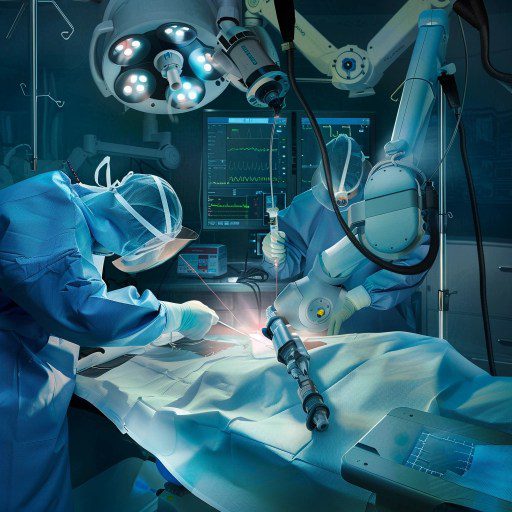
12.034,92 kilometers: this is the distance between the surgeon and the patient during the robotic surgery on September 23, 2025: a certified world record. Two hospitals, in Kuwait and Brazil, connected by a network with an average latency of 199 milliseconds and a bandwidth of 80 Mbps. Two robotic surgeries were completed: first Kuwait operated on Brazil, then the other way around. Both were inguinal hernia repairs. No complications reported.
Telesurgery has surpassed the previous record, proving that oceans and continents are no longer technical barriers. Robotic systems work, the internet holds up. We'll no longer wonder where a surgeon operates, because he can do it anywhere.
The network that made intercontinental robotic surgery possible
Jaber Al-Ahmad Hospital in Kuwait City and Cruz Vermelha Hospital in São Paulo didn't just hold a video conference on Zoom: they built a dedicated infrastructure. Zain Omantel International It designed multiple backup paths: Kuwait-Marseille-São Paulo, with full redundancy to avoid interruptions during an operation. This led to the extraordinary performance recorded: average latency of 199 milliseconds, bandwidth of 80 Mbps. This is more than sufficient for precise movements without perceptible delay.
The technology MPLS (Multiprotocol Label Switching) ensured stability. The robotic arms, commanded by Kuwait while cutting fabrics in Brazil, they performed millimetric sutures. Dr. Sulaiman Almazeedi and his team operated on a Brazilian patient. Then the opposite happened: Dr. Marcelo Loureiro and Brazilian colleagues operated on a Kuwaiti patient. They used the same procedure, repairing an inguinal hernia using a preperitoneal transabdominal approach. Both operations were completed without complications. The Guinness World Records committee has certified the record in the press conference: it's acquired.
Record numbers: 12.034,92 km distance, 199ms latency, 80 Mbps bandwidth, packet loss 0,19%. Two bidirectional surgeries completed on September 23, 2025. Surgeons: Dr. Sulaiman Almazeedi, Dr. Marcelo Loureiro, Dr. Mohannad Alhaddad, Dr. Ahmed Karim, Dr. Hmoud Alrashidi, Dr. Leandro Totti Cavazzola.
Why 199 milliseconds changes everything
A fifth of a second. Less than the blink of an eye. Yet, in robotic surgery, latency determines whether an operation is feasible or catastrophic. Below 200 milliseconds, the surgeon perceives the robot's movements as virtually instantaneous. Visual and tactile feedback synchronize. Above that threshold, the delay becomes perceptible. The surgeon's hands and the robotic scalpel become misaligned. The risk rises.
Kuwait and Brazil achieved 199 ms across two oceans. It's a bit like driving a car remotely: if the steering wheel responds half a second later, you go off the road. If it responds immediately, you drive. Remote robotic surgery works on the same principle. Sohail QadirZain Omantel International CEO explained that the network was specifically designed for “latency-sensitive applications at global scale.” Translated: Built to never fail when every millisecond counts.

Robotic Surgery: What It Means for Remote Areas
The technical record is impressive. But the practical implications are more important. Half the planet lacks access to specialized surgeons within hundreds of kilometers. Rural areas, remote islands, developing countries: geography limits treatment. Telesurgery eliminates that limitation.
A patient in a local hospital can be operated on by a specialist on the other side of the world. Without costly transfers or logistical delays. The robotic system transports the surgeon to the patient via underwater cables instead of overhead ones. Ahmad Abdulwahab Al-AwadhiKuwaiti Health Minister, called it “a clear message that the national health system can be at the forefront globally.”
It's not just rhetoric: Kuwait has demonstrated that the infrastructure is there, it works, and it scales.
Of course, massive investments are needed. Stable 5G networks, intercontinental fiber optics, multi-million dollar surgical robots. But as we have seen with robotic dental surgeryCosts drop when volumes increase. And the technology matures quickly.
The current limitations of remote robotic surgery
It works, yes. But not everywhere. 5G in China covers 99% of the populationIn many other countries, coverage gaps would make it impossible to maintain latency under 200 ms. Remote robotic surgery requires infrastructure that most of the world doesn't yet have.
Then there's the cost of robots. The Da Vinci systemThe most common type of surgical instrument starts at several million euros. Maintenance costs hundreds of thousands of euros per year. Disposable surgical instruments add additional costs per procedure. Without high volumes of use (200+ operations per year), the return on investment will not materialize. Kuwait and Brazil have the resources to make these investments. Mali, Bolivia, rural Philippines no.
And there's a paradox: telesurgery could help remote areas, but those very areas can't afford it.
At least for now.
When and how will our lives change?
Within 5-10 yearsRemote robotic surgery could become routine for complex specialties (neurosurgery, cardiac surgery). A likely scenario: regional hospitals equipped with robots, with highly specialized surgeons operating from global hub centers.
This development could reduce waiting times by 30-40% for highly complex procedures. However, standardization of 5G/6G networks and reduction of robotic system costs are needed.
Learn More
Are you interested in the evolution of robotic surgery? Read also how Saudi Arabia has reached 400 robotic heart surgeries with 98% survival.