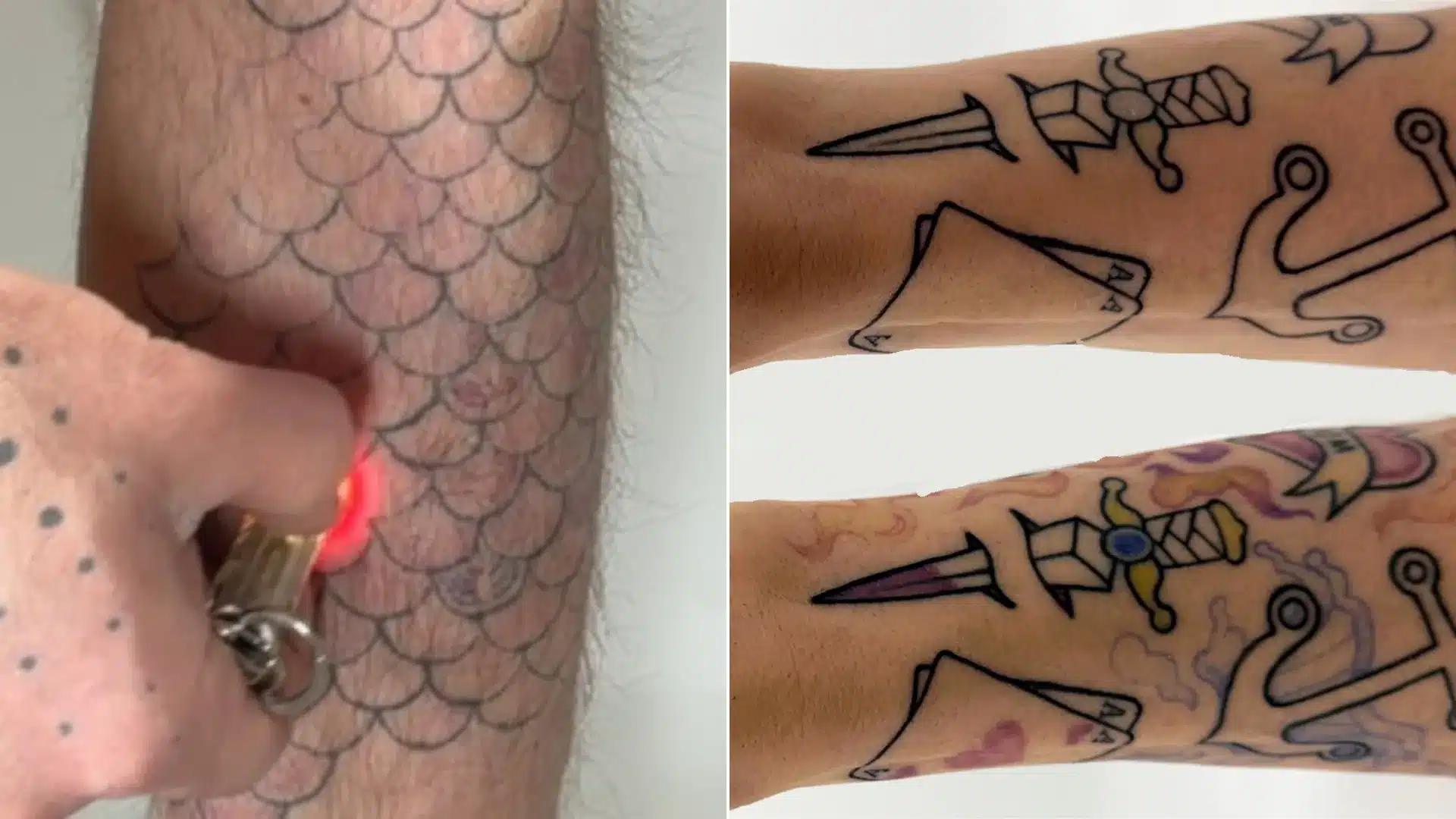
A tattoo, as we know, lasts forever, or almost: Once the ink is under the skin, a laser is usually needed to remove it. At the University of Colorado Boulder, a group of researchers led by Carson Bruns He tried another approach: tattoos that turn on and off with light, like a light bulb. The project is called PhotoTat.
Imagine an important meeting (with clients as open-minded as a ficus): you leave the drawing off in the office, but in the evening you go home and turn it back on. Bruns, who has quite a few tattoos, puts it this way: you turn it on with a UV light and turn it off when you go visit grandma. Out of affection it can be done.
How do these “switch” tattoos work?
The ink is made of tiny spheres of PMMA, a plastic similar to plexiglass used in dermal fillers and many other medical products. Inside are invisible dyes. Under ultraviolet light, they change in seconds and become the base colors of the print, and by mixing them, a complete design is obtained. A tattoo with a switch: it is turned on with one lamp and off with another. The colors fade on their own within a few hours, but a bright LED turns them off much sooner. They can then be turned back on when needed.
From the job interview to radiotherapy
The first hypothesized use for this solution is clearly aesthetic, but Bruns is also looking beyond. Many people undergoing radiation therapy for cancer receive small tattoos that doctors use to direct the beams in the right place. They last forever, and Bruns calls them "a permanent reminder of a traumatic experience." With PhotoTat, only the doctor would see them, when and if they were needed again.
We've already seen a color-changing tattoo: in 2019 that of Monaco It reacted to glucose and pH but for two out of three dyes, once it changed color, it did not go back. In 2021 it was up to the Ephemeral inks, designed to vanish in 9-15 months. They were circling around it. Now a rather interesting solution has arrived: of course, it will need to be tested on larger numbers than the current ones.
For now the only guinea pig is Bruns himself.
PhotoTat is not available in any tattoo studio, and Bruns has not yet determined whether the inks are safe for people. He, like those old scientists in the movies, tried them on himself. On her leg she has the black outline of some fish scales, filled in with new ink: with a little light they become "magical mermaid scales". In July on Journal of Nanobiotechnology a clinical trial also signed by Bruns has been released. 11 volunteers tattooed with Magic Ink, an ink that is activated by UV rays, there have been 0 adverse events. We don't know if the formula is PhotoTat's, and the authors declare an interest in the company behind Magic Ink. I'll leave you to decide.
There is much to understand about the fate of particles: in one mouse study from last December Traditional ink reached the lymph nodes within hours.
What's inside PhotoTat
Publication: Carson Bruns and colleagues (University of Colorado Boulder), on Matter & Light (Cell Press, 2026). Key dataPMMA spheres with photosensitive dyes; turns on in seconds with UV light; turns off in a few hours, or sooner with a bright LED; safety not yet determined.
When will a tattoo artist get the “on-off” tattoo?
For me, for medical or cosmetic use, it can't take less than 5 days for a first medical or cosmetic use. Safety studies and approvals are lacking for a product that stays on the skin.
Switch tattoos still have to wait. In the meantime, researchers say, anyone who wants to dabble can scribble on their skin with a simple laser pointer and watch the design fade away on its own after a few hours, as if nothing had happened. Enjoy!


