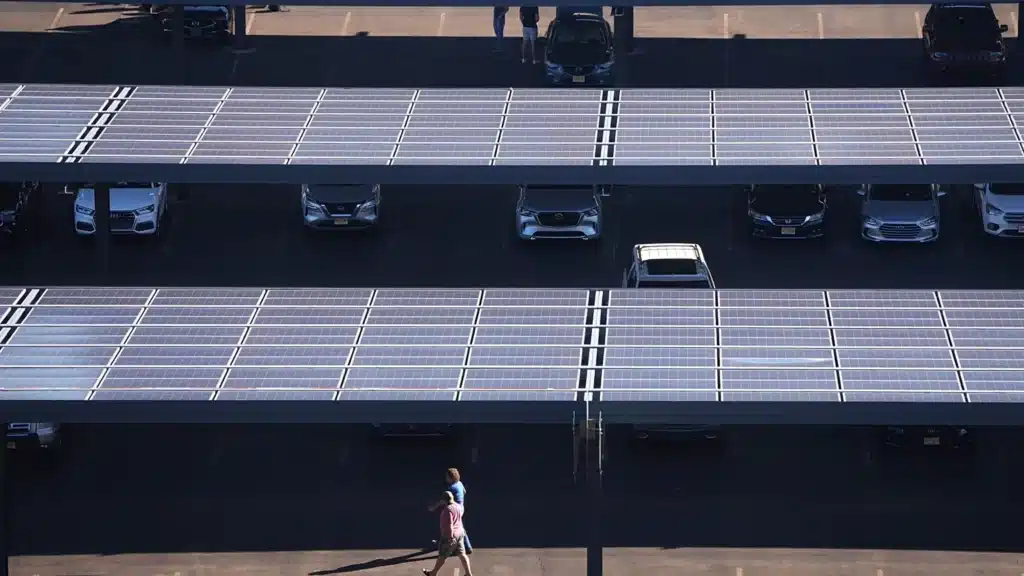
A guy called Rob Stait directs the development of alight, one of the leading solar installers in Europe, and when you ask him why solar parking lots aren't everywhere, he responds with simple facts: megawatts are generated in parking lots without consuming a single square meter of agricultural land, and charging stations for electric cars cost less because the electricity is already delivered there. The reasoning makes sense. Somewhere in Europe, someone listened and wrote a law; somewhere else, however, after a year of consultations, they decided that no, solar parking should remain a voluntary market choice.
Among the countries that listened there is France. In 2022 passed a law that requires all parking lots with more than 80 spaces to be covered with photovoltaic panels. Those with fewer than 400 seats have until 2027 to comply; those with more than 400 seats had to do so by the end of last year. For large plants, at least half the covered area must produce electricity. Fines for those who ignore the deadline can reach up to 40.000 euro a year.
According to the French government, completing the coverage adds 11 gigawatts to the national grid, enough power for twelve million homes. Last year, Paris relaxed its restrictions a bit: for areas over 1.500 square meters, it's enough to cover half the area with shade trees, or a mix of panels and greenery. Sounds good, though, don't you think?
Slovenia follows, Germany is in a patchy state
Similar rules to France apply in Slovenia for new or rebuilt parking lots over one thousand square meters. In Germany The issue is regional: installation requirements exist in Baden-Württemberg, North Rhine-Westphalia, Schleswig-Holstein, Rhineland-Palatinate, and Lower Saxony, with thresholds that vary from state to state. The European picture, in short, is one of a model spreading in stages, in no particular order, without a common directive that dictates "this is how it's done" to everyone.
Then, there is The UK, which last year had opened a public consultation to understand how unlock untapped potential of solar on British car parks. Internal estimates from the Miliband government spoke of Hypothetical savings of £28.000 per year for an 80-space solar car park that consumes all its energy on-site, with the possibility of reselling the leftovers to the grid. A real case already existed: the Leeds park-and-ride, the first British photovoltaic canopy on a park-and-ride, produces 852.000 kWh per year and offsets 471 tons of CO2The return to charging stations occurs in less than ten years. It worked, in short. But a few weeks ago the Department for Energy Security closed the game: after careful evaluation and close comparison with the industryThe ministry has decided that no, it won't go ahead. Solar parking will remain a private option, supported to the fullest extent by the Future Buildings Standard. Why?
The hidden friction between will and market
Stait defines it as a huge missed opportunity, and adds a consideration worth mentioning: relying on market forces without regulatory support is rarely enough for solar. The debates that usually slow down photovoltaic installations on agricultural land (visual impact, land use, etc.) fade away when building on top of existing infrastructure.
The cost of panels, moreover, has never been so low: since 2024 theSolar energy is on average 41% cheaper than the cheapest fossil fuel in many parts of the Union. And the issue of soil, in Italy, has been an open chapter for some time. National estimates for a requirement similar to the French one speak of 5-7 additional gigawatts, up to nine terawatt hours per year of production, without building a single shed in the middle of the countryside.
The numbers of the European match
Sources: French Ministry for Ecological Transition, British Government (call for evidence 2025), Telenord estimates on an Italian basis, IRENA Renewable Power Generation Costs 2024.
Key dataFrance estimates an additional 11 GW once fully implemented, a €40.000 annual fine for those who fail to comply, and a requirement for parking spaces of 80 or more. The United Kingdom estimates annual savings of £28.000 for an 80-space car park. Italy has a potential of 5-7 GW, up to 9 TWh/year. Average cost of solar kWh is 41% lower than the cheapest fossil fuel.
What's missing for solar parking to become the standard?
Anyone who looks at the numbers struggles to find a serious objection: the infrastructure is there, the ground is already sealed, electric cars can drive there, but what are we waiting for? The brake, where it exists, is political. Restricting the owners of large commercial parking lots means placing an initial cost on those who didn't have it in their budgets, and the choice of who pays for the transition is always a decision some people prefer not to sign.
Meanwhile, Leeds' park-and-ride continues to produce its 852.000 kWh per year without waiting for a law to cover it, as we already said for the transparent windows that generate electricityThere's electricity. Electric cars drive underneath and recharge.
Simply put, the people who should decide whether to replicate the model are currently located in five different European offices.
Solar parking: from here to a shared European model, the realistic timescales
5 to 10 years for an EU directive harmonizing obligations, 10 to 15 years for extended coverage of all large European commercial car parks.
We need a European regulatory framework that overcomes fragmentation, and above all, financial instruments to ensure that private owners don't foot the bill alone.
The first to benefit will be the large retail chains with huge parking lots and plenty of cash, which are already installing them because they see it as profitable. The last will be the small, provincial shopping centers, where no one puts €50.000 on their budget without someone to force it or finance it.
In between, for years, there will be the two-speed Europe of today.