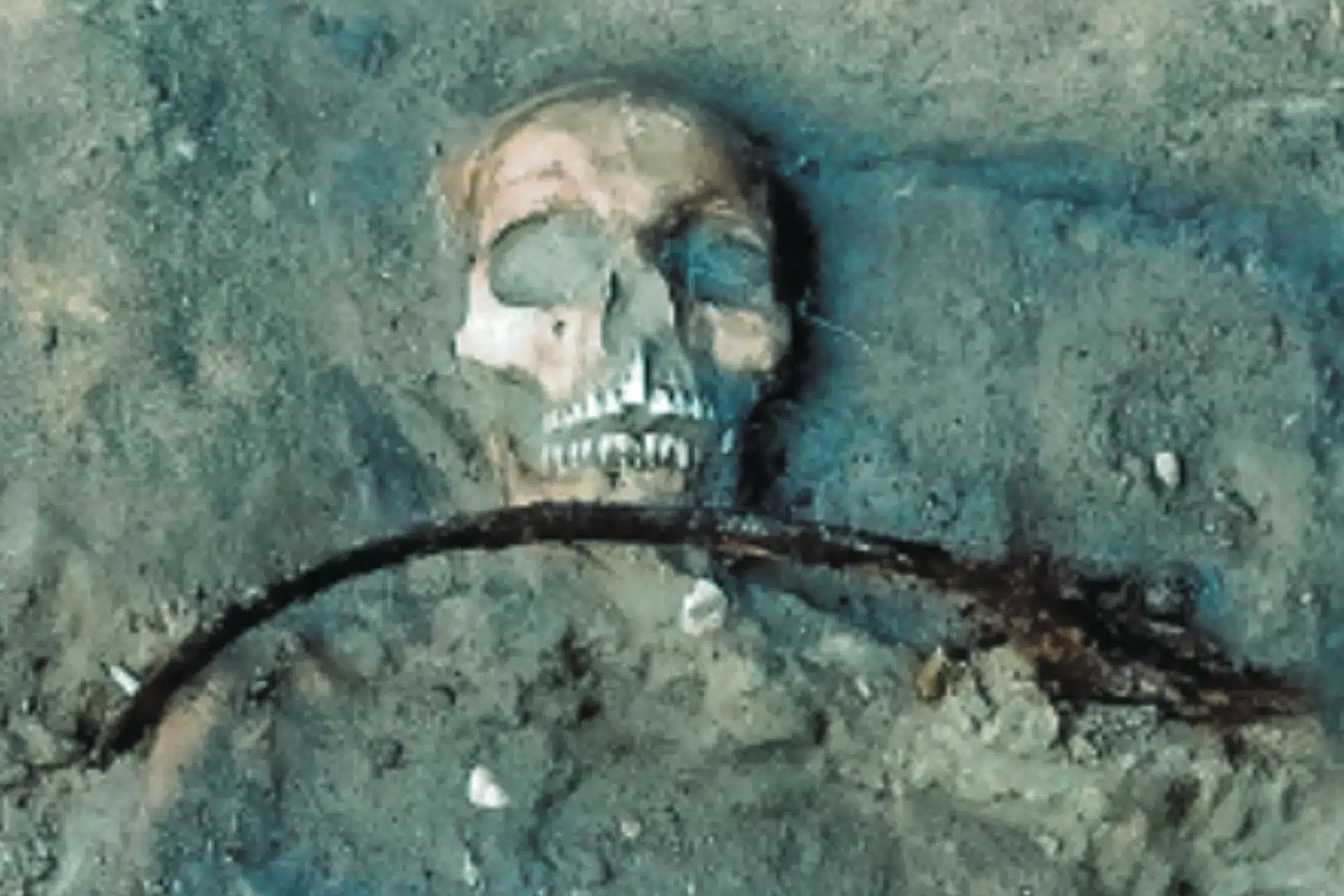
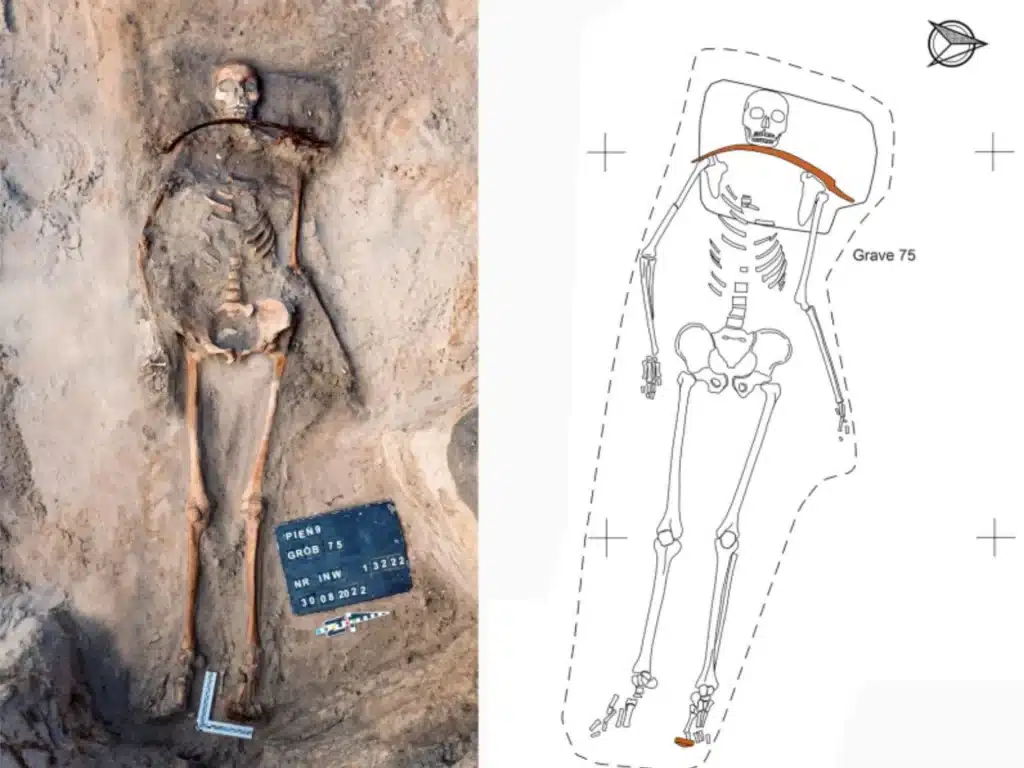
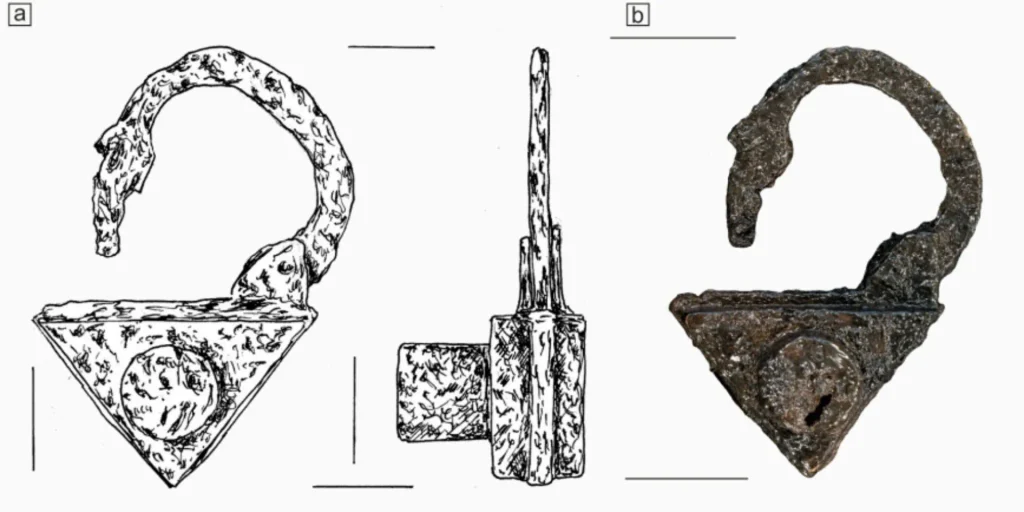
A 36-centimeter scythe bent over the throat and a triangular padlock locked around the left big toe. If I had to draw a portrait of 600th-century rural terror, I would use these two objects. They were found like this, in 2022, in a Polish cemetery that no longer appears on any map today.
The village is called Pień, in the province of Toruń. The inhabitants call her Zosia, and newspapers around the world have nicknamed her "the Polish vampire." But the name that matters most is that of the team that studied her for three years: archaeologists from Nicolaus Copernicus University, led by Professor Dariusz Polisski, have just published the full results on the DNA and isotopes of the skeleton.
What a “vampire-proof burial” really means
Before getting to Zosia, it's worth understanding what we're talking about. The term If you want toToday, it evokes Dracula: his cape, fangs, and aversion to garlic. But in 17th-century Slavic folklore, the concept was much broader and more practical: anyone who died under unusual circumstances, or was perceived as a threat while alive, risked returning from the dead to wreak havoc. The community defended itself with specific rituals: severed heads, bricks in the mouth, sharp objects positioned to prevent any reawakening.
The researchers themselves define it this way: an anti-vampire burial is any grave featuring funerary practices that aren't typical for that culture, group, or region. In practice, if you bury someone "strangely" compared to local standards, there's almost always a reason for that strangeness, and that reason is fear.
The Pień cemetery is not listed in any historical archive. No crucifixes or religious medals are among the finds: archaeologists believe it was a Protestant cemetery, perhaps reserved for those on the margins, vagrants, heretics, unbaptized children, and suicides. And, apparently, to those who were suspected of a pact with the devil.
Who really was the woman from tomb 75?
The case of the "vampire" Zosia is controversial and interesting. Because everything in the tomb catalogued as number 75, the one where Zosia was found, says two contradictory things. On one side, the threatening treatment to be neutralized: sickle, padlock, no ritual respect. On the other, the remains of a galloon, a decorative band woven from gold and silver threads on silk, the type of clothing detail that in the 600th century only those with money could afford.
Genetic and isotopic analysis, conducted in recent years, provides a precise identikit: a girl between 17 and 19 years old, raised locally but with Scandinavian ancestry. The chemical ratios in the bones indicate a slightly above-average animal protein consumption for the area: not incredibly rich, but not poor either.
The study by Poliński and colleagues
Publication: Poliński et al., Genomic and isotopic analysis of the Pień burial, published on Journal of Archaeological Science: Reports (2026).
Why a girl from a good family ends up treated like a monster
Was she a vampire? Of course not: so why does a seventeen-year-old in a silk hat end up buried like a menace to be nailed to the ground?
The period helps to understand, even if it doesn't justify much. We are in the Little Ice Age: harsh winters, failed harvests, epidemics that return in waves. In such a world, someone must be responsible for the disaster. Poliński hypothesizes that Zosia was blamed for precisely this—disease, famine, local misfortunes—with that blame placed on the returning dead.
A detail published in a previous investigation mentioned a protruding incisor: an anomalous physical trait that, in a 600th-century village, could be enough to brand someone as different. Nothing else was needed, back then, to transform a girl into a threat to be defused with a scythe.
The cause of death remains unknown: there were no signs of trauma to her bones. Some hypothesized, years ago, that it was a condition that caused her to faint or experience severe headaches, but researchers remain cautious: without visible trauma, the question of how Zosia died remains a gaping hole in the story that not even DNA can fill.
Will we solve this mystery with future technologies?
Probably never entirely. Zosia's cause of death may never emerge: without bone trauma, without soft tissue, archaeology only gets so far.
What may still emerge is a broader genetic comparison with other Polish anti-vampire burials, in Drawsko and elsewhere, to understand whether there really was a recurring profile behind these practices, or just the fear of the moment applied to anyone who happened to be within range.
In 2024 a documentary, Vampire Field, tried to give Zosia a reconstructed face. But the real face, the one depicted in the recently published study, has no fangs or a menacing look: she's 17, comes from a family that could afford silk, and has probably done nothing wrong.
He just had the misfortune of dying in the wrong year, in the wrong village, with a crooked tooth.


