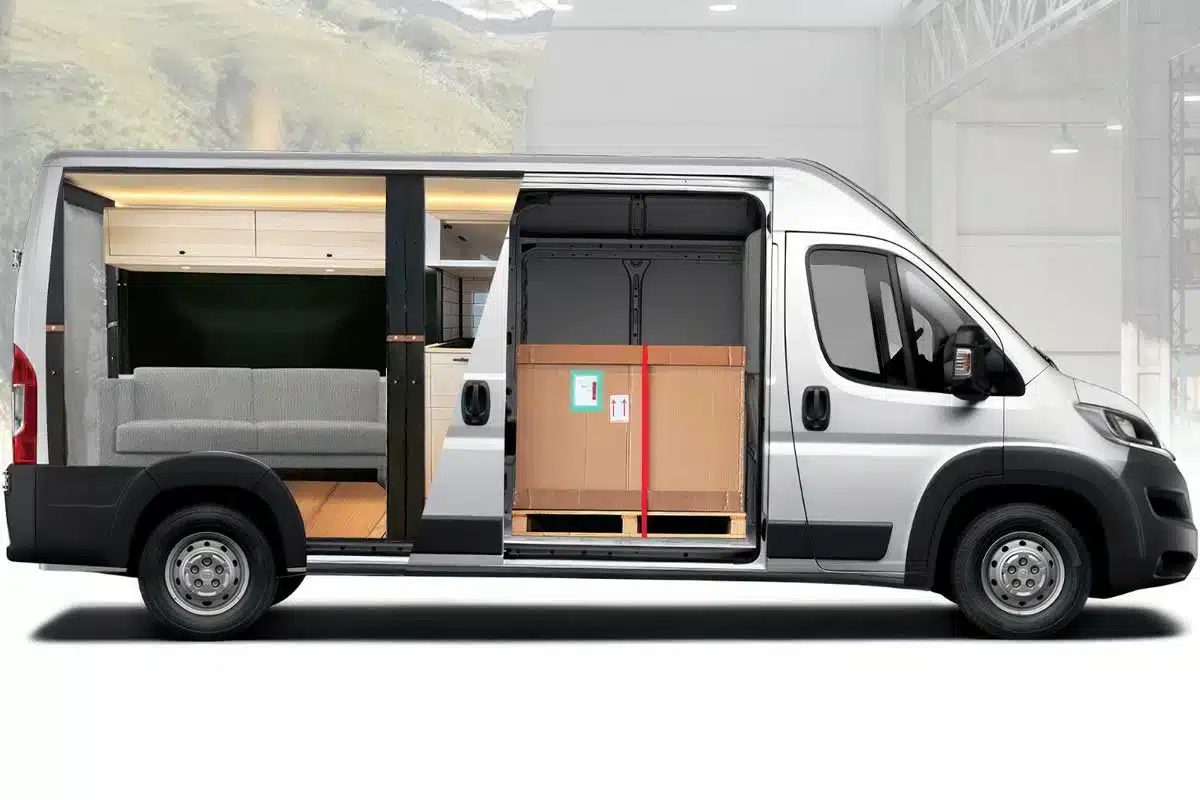
There is a small company in Galicia that is driving all the European van life enthusiasts crazy. It is called Van Cubic and invented something that seemed impossible: a camper kit in modules that transform an empty van into a complete camper without the need for tools, approvals or technical skills.
The secret is in a system of rails and hooks designed to be 100% reversible. And do you know how much this costs? Less than what you would spend to “camperize” a van in the traditional way.
Two modules for a complete camper kit
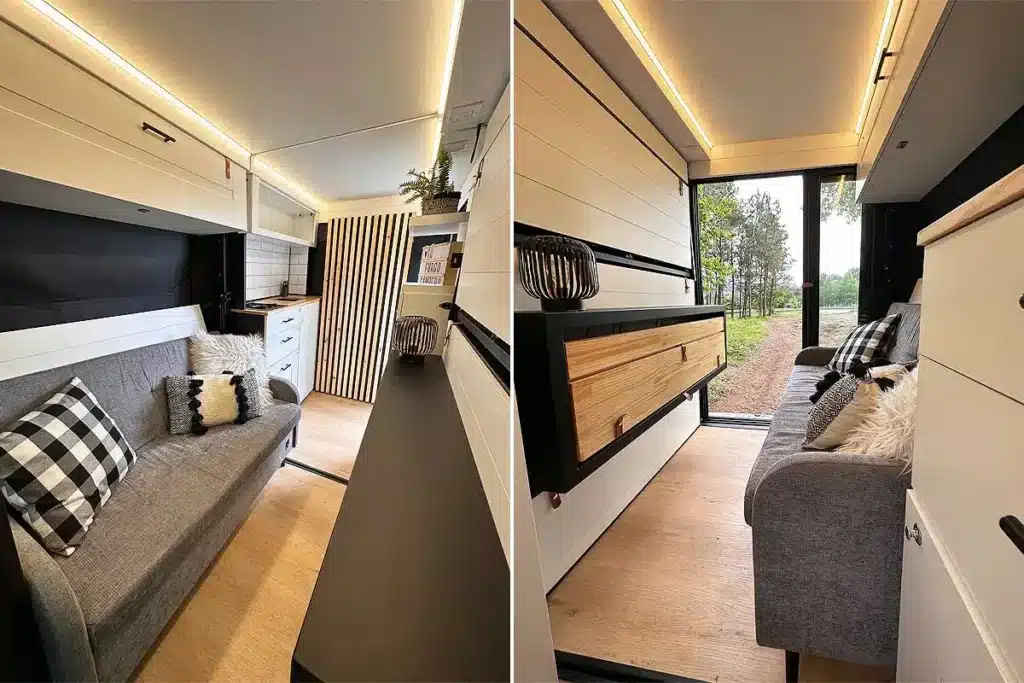
The heart of the VanCubic system is two self-designed modules that fit perfectly into the cargo area of any L2H2 or larger van. The first module combines kitchen and bathroom in one incredibly compact yet functional space. The bathroom uses a retractable system with a shower tray that lowers from the wall and a curtain that extends from above when needed.
The kitchen includes a gas stove, sink, full-height refrigerator and even a dishwasher (yes, you read that right). The second module houses the living area with a sofa that converts into a 120×190 cm double bed, using the entire width of the van. As an option, you can add bunk beds, a folding table and additional wardrobes.
No homologation, no bureaucracy
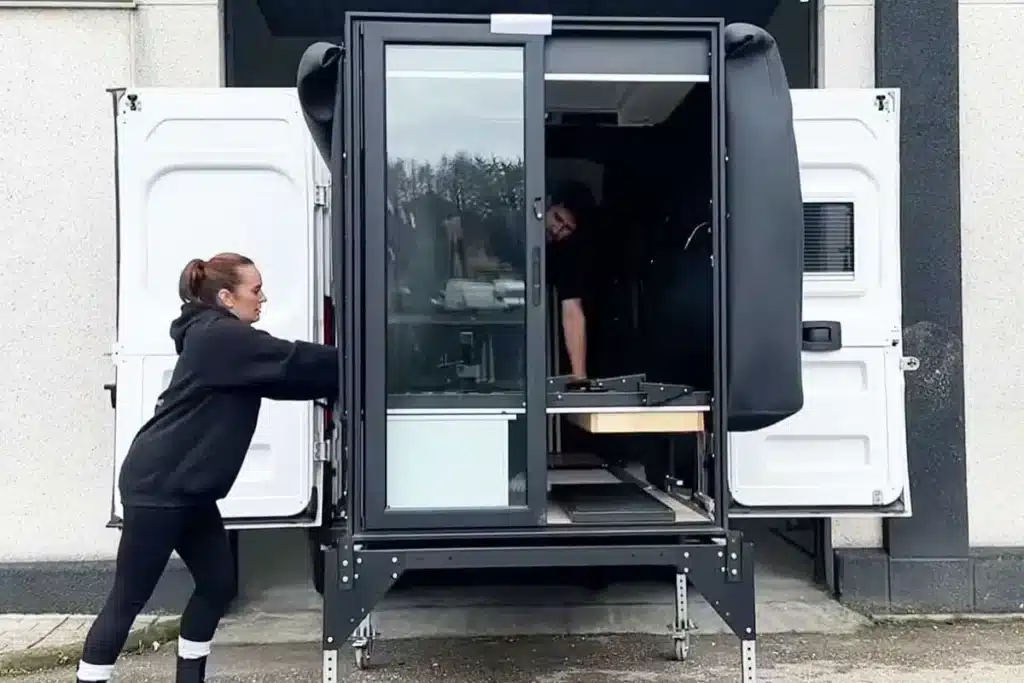
The real innovation of VanCubic is not only in the design, but in the installation system that completely bypasses the homologation regulations. The modules are fixed via rails and attachment systems that do not require permanent modifications to the vehicle. According to Italian law, removable structures that can be removed without tools do not require changing the use of the vehicle.
This means that your van technically remains an N1 truck, with all the economic and bureaucratic advantages that this entails. As highlighted by several industry experts, you can circulate freely without risking sanctions, as long as you can demonstrate the immediate removability of the modules.
The Expanding Modular Camper Kit Market
VanCubic is not alone in this revolution. Italian companies like MVan e Coming Together offer similar solutions with prices starting at 2.600 euros for the basic modules. In Spain, Camperize produces modular kits starting from 499 euros for the plywood version.
The success of these camper kits lies in their flexibility: you can start with a basic module and add elements over time, according to your needs and financial possibilities. As the experts at AutoEvolution explain, VanCubic modules are compatible with Ford Transit, Fiat Ducato, Mercedes Sprinter and Volkswagen Crafter.
Prices and future prospects
VanCubic offers three configurations: Basic, Loft and Premium, with prices starting from 15.990 euros. According to NewAtlas, each module includes a portable Ecoflow battery to power LED lights and a water pump, while heating is provided by portable electric stoves to maintain removability.
Jordan Diaz e Ivan Bastero, founders of VanCubic, have already sold more than 50 modules and plan to open new points of sale in France by 2025. As I told you in this article, modularity represents the future of camping, even if in more sophisticated versions.
VanCubic in 2026: Updated prices and where to buy it
On the official website the price list today talks about 15.990 euros for the Basic, 20.990 for the Loft and 23.990 for the Premium (with financing of 325, 425 and 485 euros per month). A second page adds a version Origin by 11.990 euro, for those who already have a van. This is confirmed. Startup Selfie (June 20, 2026): Prices including VAT and excluding transport, with collection in Vigo, Origin at €11.990, Loft at €20.990, Premium and 360° at €23.990, plus €3.000 for the Origin Plus Pack. After doing the math, the entry-level price drops by €4.000, or 25%, compared to the €15.990 mentioned above, but it's a more stripped-down version. A Spanish dealer, Voyenvan, lists Loft at 17.347 and Premium at 19.826 euros without saying whether VAT is included, while the French price list cited by Motorhome He speaks of a range between 16.690 and 25.990 euros, confirming that the final price depends on where and what you buy it with.
On availability
The website states delivery in 15 days and installation in about an hour, and production is in Galicia. For Italy, the situation is less clear: March 2026. La Voz de Galicia, taken from OpenVan.camp, wrote that the company has raised 500.000 euros from three funds (Eoniq.fund, F e Attico Ventures), has 20 employees and is preparing a network of distributors in several European countries, with a center in Forlì for the Italian market. I have not found confirmation that the center has yet opened, nor shipping costs or resellers in Italy: currently, the documented route passes through the company, with collection in Vigo.
The issue of homologation remains, on which the article above is very clear. The company states that the modules count as cargo secured with approved straps, so they don't require homologation and don't require disassembly for the ITV inspection (Spanish standard), while in France Motorhome writes that no DREAL paperwork is required. Startup Selfie points out that the benefit depends on each country's regulations, and for Italy, the only sources I found were the industry sources cited above, not a circular from the Department of Motor Vehicles. For technical requirements, the van must be L2H2 or larger, with a load compartment height of at least 1,90 meters, and modules weighing approximately 300-350 kg each, up to approximately 700 kg in total. As for Italian prices, Our overview of camper kits for the Ducato compares different modular solutions.
The idea of being able to transform your work vehicle into a mobile weekend home, without touching screws or dealing with bureaucratic procedures, is conquering a growing market share. And frankly, after seeing how these systems work, it is difficult to imagine going back.


