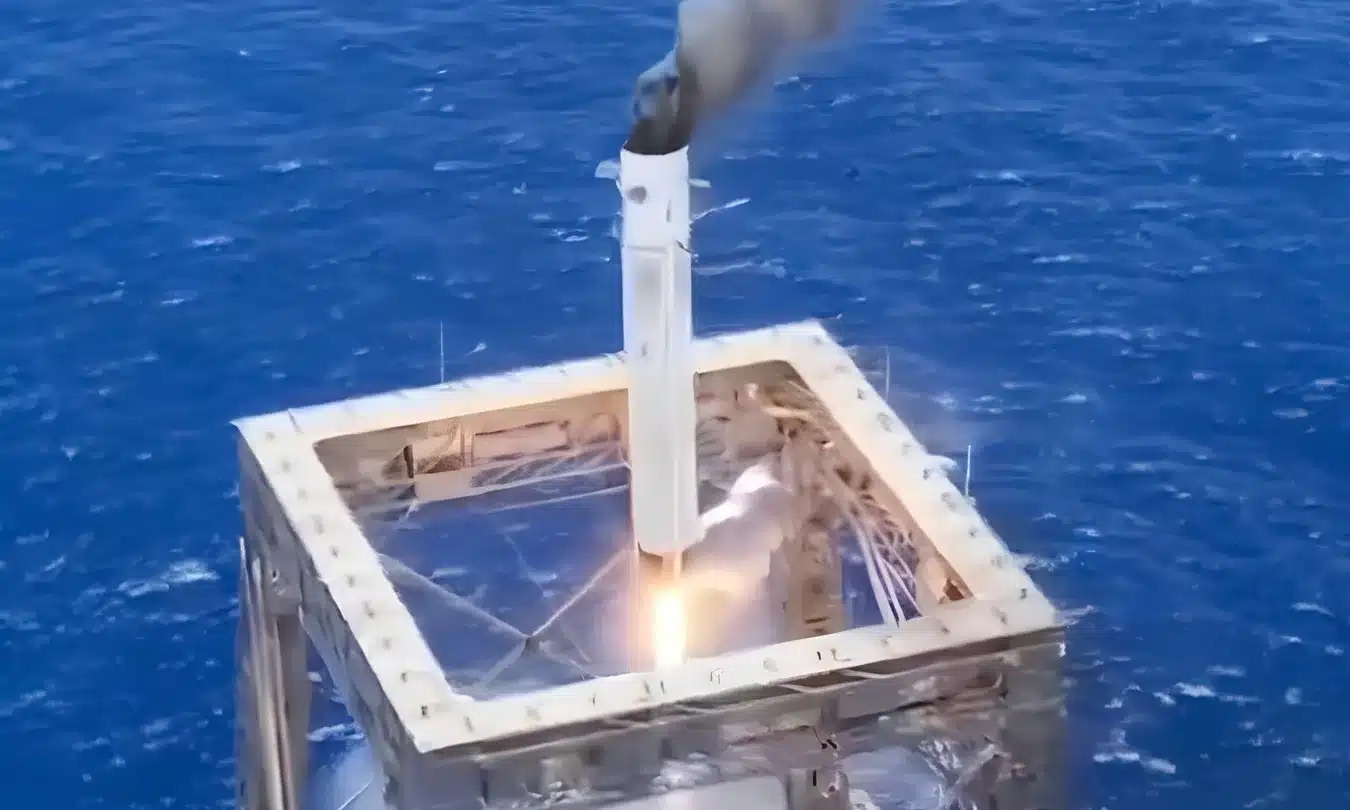
Chen Muye works for the China Academy of Launch Vehicle Technology, and at the news agency Xinhua He said something simple: landing "rods," the ones everyone has associated with reusable rockets since SpaceX, are a damned problem. They weigh, they take up space, and ultimately they steal payload. Long March 10B, the stage recovered on July 10th off the coast of Hainan, completely circumvented that problem by replacing SpaceX's "rods" with... a rocket-catching net (I don't know how else to define it).

The system works like this: 6 minutes after separation from the second stage, the first stage of the rocket descends vertically, braking with its engines, towards a specially equipped ship: the Linghangzhe, which in Chinese means roughly "she who indicates the route." At that point, four hooks mounted on the rocket attach cables stretched across the deck, and a hydraulic system absorbs the residual energy of the impact.
No “wand”, as mentioned, and no vertical descent like those to which SpaceX has accustomed us with Falcon 9: just a fishing net species, enlarged and engineered.
The rocket in numbers
Mission: first flight of the Long March 10B, launched by the China Aerospace Science and Technology Corporation (CASC) from Hainan Commercial Space Launch Site July 10, 2026, 12:15 PM local time.
The debt that no one hides (and no one admits)
Il Long March 10B shares the first stage with the Long March 10A, Designed for China's manned flight program to the Moon, the comparison to the Falcon 9 isn't just made by incredulous journalists. CASC itself does so, in every press release, every time it describes how its rocket does differently from SpaceX's.
There's no need to read between the lines: it's written in every technical comparison, in every table with two columns side by side. No one calls it copying: everyone, however, continues to mention the model to be surpassed.
So the question to ask, quietly, is how much of this is truly a technical alternative and how much is a declared catch-up. The honest answer lies somewhere in between. The net system is not a stopgap: Chen Muye explained to Xinhua that it reduces onboard mass, increases payload, and that the coordinated hooks "expand the capture window" compared to a "foot-first" landing. In other words, it tolerates trajectory errors better.
However, there remains a different solution to a problem that SpaceX has already solved for years, which came after two more Chinese rockets with "legs" (Long March 12A and Landspace's Zhuque-3) had failed recovery attempts around the same time. There's no getting around it: this script was first written for me in Hawthorne, California.
How much does this record really weigh?
The technical primacy is real, and it is not even the first time that China has tried it: already in 2022 we were talking about a “lasso” capture project which then remained on paper. No other space program has ever captured an orbital booster with a net. But the important goal, that of the launch rate, is another: SpaceX is launching today at a rate that is roughly double that of all Chinese rockets combined., and US Space Force officials themselves have publicly stated their concern about when that gap will close. A successful recovery doesn't close it. It just closes it, perhaps, a notch.
The true times of the stream
Estimated horizon: 1-3 years for regular recovery and reuse of the rocket.
The problem is no longer the capture, which has now been demonstrated: it is repeating it with the same reliability as Falcon 9, which took years to reach a launch per week.
In practice, whoever gets to fly a plane again first? Long march, not only to recover it, he will have in his hands the only thing that really matters in this match.


