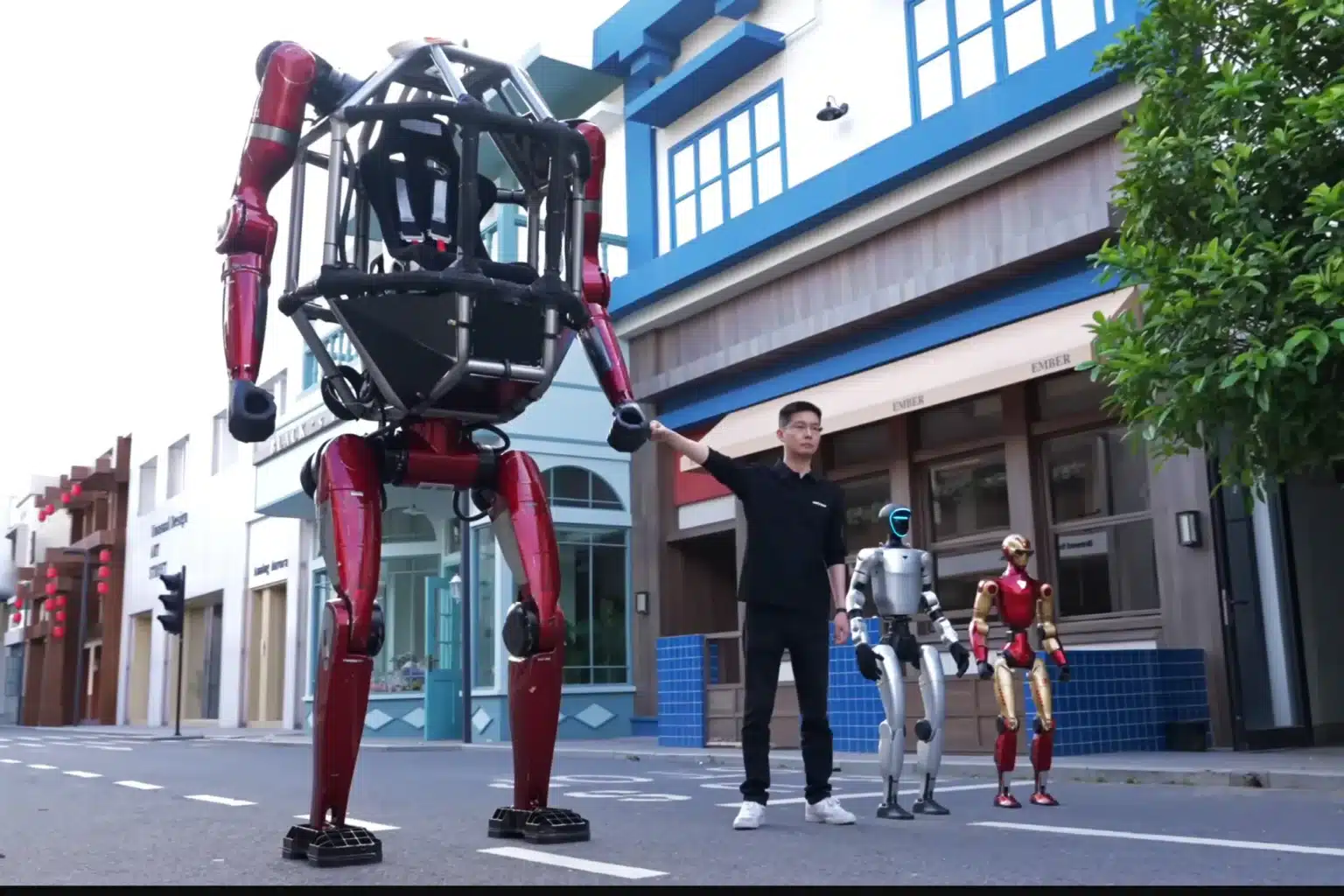
Unitree presented the GD01, described as "the world's first mass-produced pilotable mecha robot." It weighs 500 kilograms with a pilot inside, stands about 2,7 meters tall, and costs from 3,9 million yuan ($650). It walks on two legs, knocks down a brick wall with its fist, then bends forward and transforms into something resembling a four-legged mechanical horse. The company calls it a "civilian vehicle." What that means, exactly, no one knows. Not even Unitree, if you look at it.
What does this mecha robot really do?
The promotional video lasts one minute and shows Wang Xingxing, founder and CEO of Unitree, climbs into the cockpit. A gaming chair seat (it looks just like one, and it probably is), a metal roll bar, and various levers add to the mix. The mecha robot takes off, takes four stiff steps across a workshop floor, raises a thin arm like a compass, and pulls down a column of bricks. The structure holds, no strange vibrations, no embarrassing falls. For those who follow the company since the H1 sprint days, not surprisingly: the Unitree mechanics are mature. It's what happens next that makes you think.
The GD01 leans forward, supports its arms, and transforms into a quadruped. It works, walks, and changes configuration in a matter of seconds. Except that the seat doesn't rotate with the machine: it remains fixed, facing forward. When the robot switches from biped to quadruped, the driver sitting inside ends up looking at the ceiling, with his knees over his face. For $650, a solution to the problem wouldn't have been bad, but you know what I mean: early adopters always end up being guinea pigs for better solutions.
Okay, but what good is a half-ton pilotable mecha?
Unitree, as I mentioned, presents the GD01 as a "civilian transport vehicle," but doesn't explain what problem it solves. A 500-kilogram mecha that walks at a walking pace, is awkward to get in and out of, has limited autonomy (battery life hasn't been disclosed yet), and costs as much as six Ferraris; it's not a means of transportation. It's a toy for the very few.
The hypothetical use cases mentioned by Chinese experts (theme parks, immersive entertainment, filmmaking, rescue in extreme environments) are all niche scenarios that typically use specialized machinery that costs much less. A pilotable mecha robot in a factory? A forklift costs five thousand euros and won't leave you hanging. In a disaster zone? Excavators, drones, and four-legged robots already exist. The truth is that the GD01 doesn't solve an existing problem: it creates a new one: that of finding a purpose for it after the fact. Let's hope that purpose isn't the usual one, namely military.
The mecha robot as a marketing stress test
Unitree isn't selling a product; this is an advertiser speaking to you. They're doing something different, and they're doing it very well: permanently occupying the "future from China" niche. They've already done it with the kung fu G1, the 10-meter-per-second H1, and the quadruped firefighter. Now they're adding anime-inspired mecha. Every six months, a video garners tens of millions of views, a deliberately incomplete spec sheet, and the ritual closing phrase: "We ask users not to make dangerous modifications." Said to anyone buying a half-ton robot.
The industrial context, meanwhile, is less cinematic but much more solid. Chinese companies accounted for nearly 90% of global humanoid robot sales in 2025, according to Omdia. Unitree alone shipped over 5.500 units last year. Tesla, Figure AI, and Agility Robotics each shipped about 150 units over the same period. Calculating the hourly cost of a humanoid robot explains why the Chinese government is accelerating: once fully operational, an hour of robotic labor will cost less than two dollars. The GD01 has nothing to do with that market. It serves to keep Unitree's name in global pop culture while the real battle, the one on industrial bottlenecks, the fight is taking place elsewhere and in silence.
When will we really see it?
Estimated horizon: on sale now, real applications who knows.
The GD01 is available for order, but Unitree itself describes its price of 3,9 million yuan as "indicative": the final production version could cost differently. It will be purchased by Asian theme parks, big-budget film productions, and some billionaire who already has a Bugatti in his garage. For any serious "civilian" use (rescue, inspection, construction), autonomy, ergonomics, certifications, and a price that don't exist today are needed. Translation: you'll see it on TikTok, but I don't think it'll be on a construction site. At least for the next five to seven years. Then, perhaps, we'll see something derived and smaller for specific industrial applications. The seat, perhaps, will even rotate by then.


