
What would happen if the walls of your home purified the air instead of polluting it? This is what they're experimenting with in Germany with natural insulation panels made from mycelium: mushrooms that grow on straw waste, become building material, and continue to absorb CO2 throughout their lives. This technology transforms the very concept of insulation from an environmental problem to a climate-active solution.
The project is called Mycobuild and it comes fromHof University of Applied Sciences: It has something magical, but it works with the ruthless logic of nature. German researchers take dry straw, add mycelium (the underground network of mushrooms) and wait. In three days the material self-assembles, forming compact panels that breathe, insulate and They do what no polystyrene in the world would ever be capable of doing: they improve the environment instead of harming it.

How natural insulation that grows on its own works
Il Professor Robert Honke, who leads the project, explained the production process of these "new" natural insulators with a precision that belies years of experimentation. As mentioned, first a substrate is prepared with local plant residues (mainly dry straw). Then the mycelium selected from native German species is introduced (oyster mushrooms, pleurotus, bolete) that grow at room temperature without the need for heating or cooling.
The mycelium spreads through the material within a few days, binding the components together like a natural glue. Once the desired density is reached, the process is stopped by drying and controlled heating, which inactivates the fungus and stabilizes the structure. The result? Rigid, lightweight, and surprisingly durable panels.
Laboratory tests have shown that Mycelium outperforms of fiberglass, mineral wool and extruded polystyrene for both thermal and acoustic insulation. According to the Dr. Katharina Wellmanns, the thermal conductivity reaches values of 0,024 W/mK, comparable to the best synthetic insulators but with an unexpected advantage: the production process is carbon-negative.

Mold problem solved with mineralization
There's one detail that makes all the difference. German researchers have realized that mycelium, as natural as it is, has a weakness: humidity can promote the formation of unwanted mold. The solution came from a collaboration with Johann Bergmann GmbH & Co. KG, a company specializing in building materials.
They have developed a mineral coating that protects the panels from moisture without compromising their insulating properties. It's a bit like putting a raincoat on a mushroom, but leaving it able to breathe. What's more, tests show that this layer not only protects the material, but also increases its mechanical resistance.
Wellmanns emphasized that substrate selection is crucial:
“The material must provide enough nutrients for optimal mycelium growth, but not too many sugars that could promote unwanted germs.”
Beyond the panels, in the Czech Republic there is an entire mushroom house
Anyone who follows this site will have heard of it. It's one of those projects we've been following since the beginning, and we've even developed a good correspondence with the authors: Czech Republic they went beyond simple mycelium walls SAMOROST House is the first building in the world built entirely of mycelium, designed by the architect Tomasz KlozaTwo giant mushroom-shaped structures, one for the living area and one for the bedroom, both made with these natural insulators.
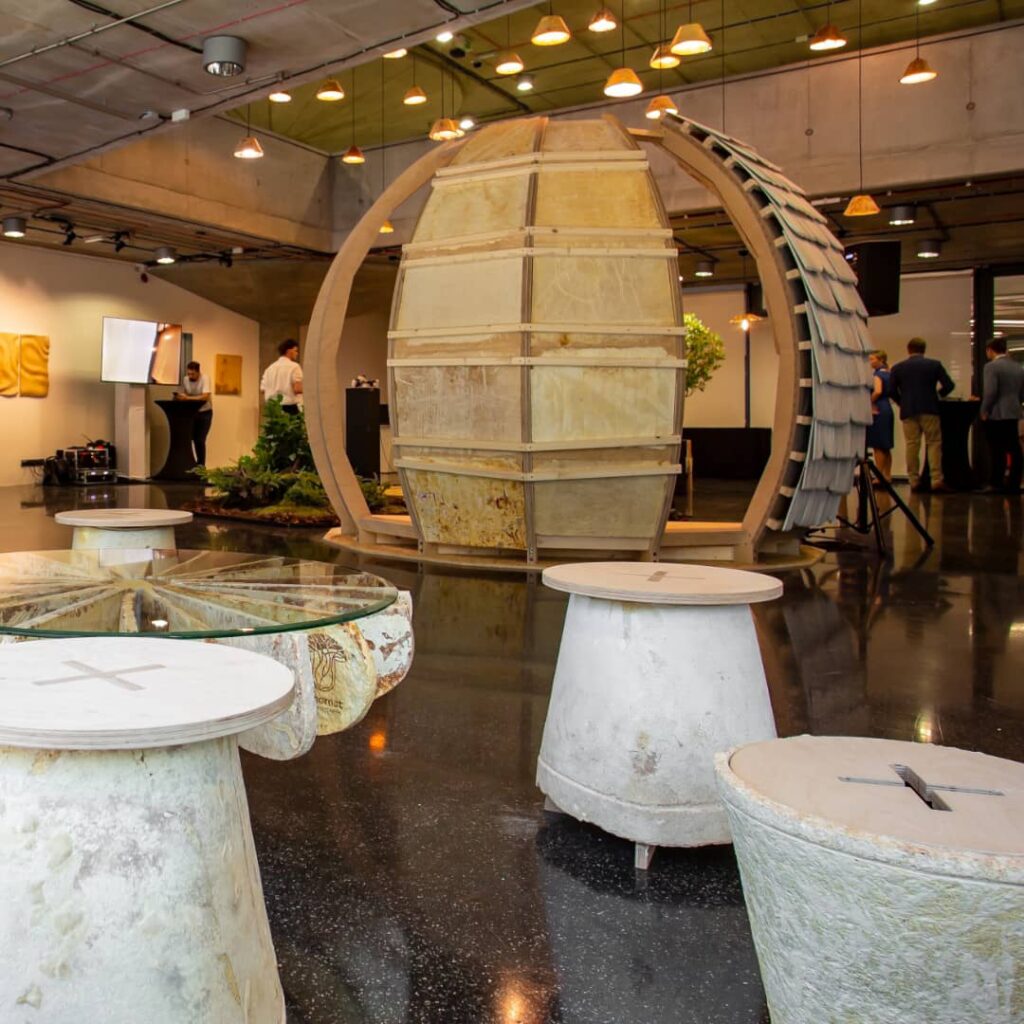
The Czech project proves that this is not just a laboratory curiosity. Tests conducted in 2023 and 2024 confirm that Mycelium can completely replace synthetic materials for thermal, acoustic and even structural insulation. It's green building that literally grows by itself.
International research also confirms the potential. A study published in Advanced Sustainable Systems highlights that mycelium composites can absorb up to 75% of sound at frequencies below 1,5 kHz, making them ideal for soundproofing. Again: Nanyang Technological University of Singapore has developed mycelium tiles that mimic elephant skin for the passive cooling of buildings.
Industrial production by 2026. Maybe.
Returning to Germany, Hof's team is aiming for industrial production by 2026, supported by the program DATApilot of the German government. But Honke is honest about the limits:
“Many people might be skeptical about a fungal-based insulation, fearing mold problems in their homes.”
It's an understandable concern, considering we're talking about growing mushrooms in walls. Production requires rigorously sterile conditions and precise control of growth parameters. Even a small contamination can ruin an entire culture. It's like growing orchids: beautiful when it works, frustrating when it goes wrong.
But the advantages are clear, even in ecological terms. The production cost of mycelium is significantly lower than that of synthetic materials, especially because it uses agricultural waste as a raw material. It's applied circular economy: what previously ended up in landfill now becomes quality thermal insulation.
If natural mycelium insulation panels can scale up to industrial production…
we will have homes that not only do not pollute, but actively purify the environment.
A future where walls breathe, grow, and care for the air we breathe. Not bad for something that starts out as straw scraps and forest floor mushrooms. Or not?


