
When Caitlin Casey at UC Santa Barbara first saw the raw data from the COSMOS-Web project, he probably thought there was a mistake. Ten times more galaxies than expected in the early universe is not exactly what you expect to find when you're mapping the cosmos. But there they are, these little dots of light that tell a story entirely different from the one we thought we knew. The map of the universe that Webb has just delivered to humanity is a scientific bombshell that is shaking the foundations of modern cosmology.
A world-record map of the universe
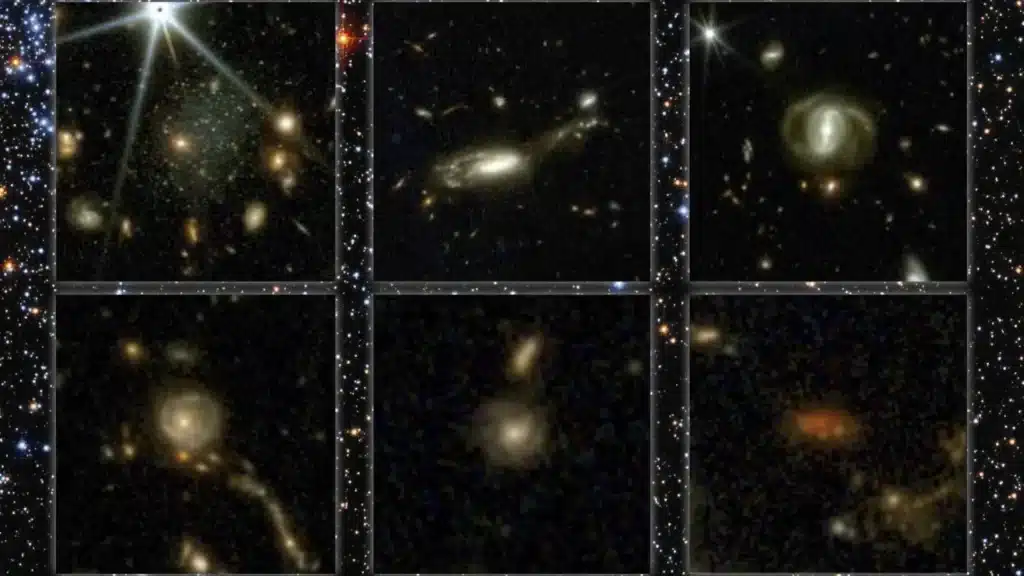
The COSMOS-Web project has just released something that no one has ever seen before: the Largest and most detailed map of the universe ever created. We are talking about almost 800.000 galaxies catalogued in an area of sky equivalent to three full moons. Caitlin Casey, co-leader of the project together with Jeyhan Kartaltepe of the Rochester Institute of Technology, explained the ambition behind this monumental work.
The James Webb Telescope has pointed its incredible infrared power at the COSMOS field for over 200 hours of observations, collecting data covering 98% of cosmic history. We are talking about galaxies that existed when the universe was only 400 million years old, shortly after the Big Bang. The research will be published in the Astrophysical Journal, the most prestigious astrophysics journal in the world.
There's just one tiny problem: these galaxies aren't supposed to exist.
At least not in such large numbers. Before Webb came online, Casey and his colleagues had made their best predictions based on current cosmological models. The early universe would have been relatively empty, with a few galaxies scattered about as gravity slowly began to pull them together.
instead, Webb has revealed a primordial cosmos ten times more populated than expected. “The big surprise is that with JWST we see about 10 times more galaxies than expected at these incredible distances,” Casey said. And it’s not just a miscalculation: We’re also seeing supermassive black holes that were completely invisible to Hubble.
How Webb's Universe Map Works
The brilliance of COSMOS-Web lies in its observing strategy. The team used Webb’s Near Infrared Camera (NIRCam) to capture images in four different filters, creating an unprecedented multispectral mapping. The project combines data from Webb and Hubble to provide a comprehensive view of galactic evolution.
But why the COSMOS field? This region of sky was chosen because it has very few stars or gas clouds that could block the view of the deep universe. It's like having a perfectly clean window to look back 13,5 billion years in time.
The Democratization of Cosmic Science
One of the most interesting features of this project is the open science philosophy adopted by the team. The data was made public almost immediately, allowing researchers around the world to use it for their own discoveries. “The best science happens when everyone thinks about the same dataset differently,” Casey said.
This map of the universe isn't just for professional astronomers: even college students can now explore early galaxies using interactive online tools. It's a paradigm shift that as we have discussed in the past represents the future of collaborative scientific research.
When Cosmological Models Go into Crisis
If the early universe was so active and populated, it means our models of galaxy formation need to be completely revised. “We’re wondering if these JWST datasets are breaking the cosmological model,” Casey said.
The problem is that the universe only had 400 million years to form something like a billion solar masses of stars. With the laws of physics as we know it, we simply don't know how this is possible.
The Future of Cosmic Research
This map of the universe is just the beginning. The COSMOS-Web team continues to collect data and use spectroscopy to confirm the distances to the most remote galaxies identified. Each new observation could reveal even more surprising details about the interstellar chemistry of these primordial systems.
The COSMOS collaboration represents more than 100 scientists in a dozen countries, all united in their quest to decipher the mysteries of the early universe. And if this map of the universe has taught us anything, it's that the cosmos still has many surprises in store for us.
Perhaps the most fascinating thing is the realization that, despite all our technological advances, the universe continues to amaze us and remind us how little we really know. This map is not just a collection of galaxies; it is a humble reminder of our smallness in the face of immensity.


