
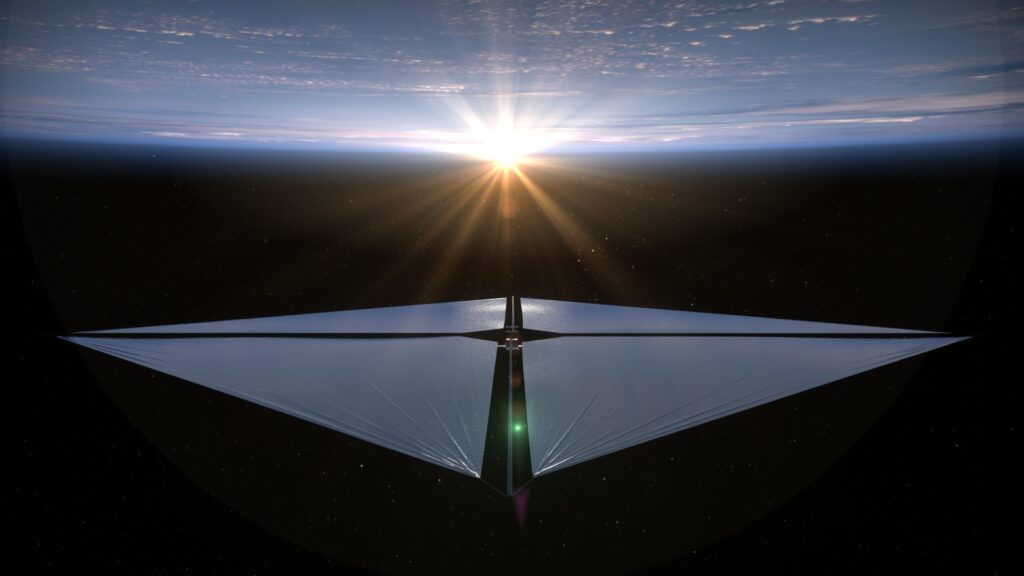
The cosmic void has witnessed an extraordinary event. Up there, where silence reigns supreme, NASA's solar sail has opened like a metallic flower. A reflective sheet the size of half a tennis court now floats in space. It is the beginning of something big: from today, light becomes our passport to the stars.
A leap into the future of space exploration
The solar sail, part of the project Advanced Composite Solar Sail System (ACS3) NASA, has finally spread its wings after a four-month journey into space. Launched on April 24 aboard Rocket Lab’s Electron spacecraft, this futuristic technology promises to revolutionize the way we explore the cosmos.
On August 29, at 17:33 UTC, the mission team received the long-awaited confirmation: the sail deployment system worked perfectly. It is a moment that marks a turning point in the history of space exploration.
How does NASA's solar sail work?
Even though photons have no mass, they can exert a force when they hit an object. It is as if light were an impalpable but constant wind. The solar sail, with its reflective surface of about 80 square meters, captures this “breeze” of photons to move through space.
No fuel is needed, no noisy engines. Just a thin sheet dancing silently among the stars, driven by the light itself. It is a mix of poetry and engineering fused into one magnificent instrument. And we will be able to witness its “concert”: the spacecraft carrying the solar sail is equipped with four cameras that provide a panoramic view of both the reflecting sail and the support arms.
We will soon have high-resolution images of this cosmic spectacle. On September 4, we could witness one of the most fascinating space selfies ever taken.
A moment of history
It is worth remembering that the original idea of solar sail propulsion in space was by Prof. Joseph Columbus, of the University of Padua, a NASA collaborator, over half a century ago. He died prematurely of cancer. We also owe to his lively mind the idea of the satellite on a leash and the amazing result of the Mariner 10 probe. I remember his sparkling gaze and the childish enthusiasm when he returned from meetings at NASA and told us…
A beautiful tribute that Roberto Sannevigo, President of Padua Planetarium, sent us via email.
Testing our new “cosmic sailing ship”
In the coming weeks, the solar sail will undergo a series of crucial tests. Engineers at the NASA will carefully observe its maneuverability in space. By modifying the orbit, researchers will collect valuable data that will be used to design and manage future missions equipped with solar sails.
The applications of this technology are many and exciting. Rocket Lab, NASA's partner in this mission, has outlined scenarios that seem to come from a science fiction novel:
- Early warning satellites for space weather conditions
- Reconnaissance missions on asteroids and other minor celestial bodies
- Exploration of the polar regions of the Sun.
The solar sail could pave the way for cheaper and more sustainable missions, allowing us to push further into our solar system and beyond.
Solar Sailing, the Future is Already Here
NASA's solar sail is tangible proof that the future of space exploration has already begun. With this technology, we are opening the doors to possibilities that until yesterday were considered science fiction.
Where will this new era of space exploration take us? What wonders will we discover, driven only by the light of the stars? The journey has just begun, and it promises to be spectacular.


