
cyclotech, the industrial group behind some unusual vertical thrust engines, is partnering with Yamato (Japan's largest delivery company) to develop a one-of-a-kind cargo drone.
The UAV is powered by six Voith-Schneider cylindrical vane engines (if you want to know more) which work on the principle of cycloidal blades. The main feature of the mechanism is that it turns quickly, constantly changing the angle of inclination to provide adequate traction. The project for this cargo drone is called CCY-01: the name says nothing, but the nickname (I'll tell you later) is nice. And the look is incredible!
CCY-01: hey, babe
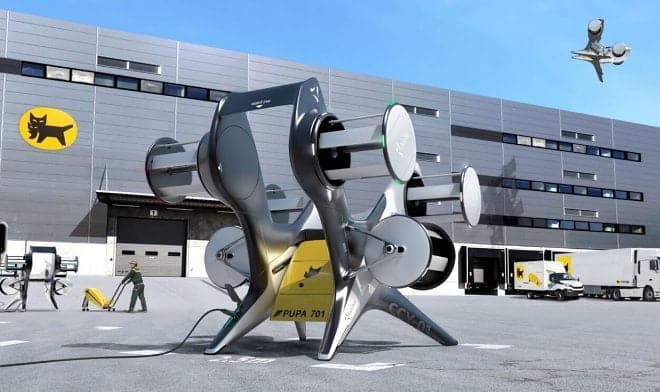
The Yamato-Cyclotech drone has six rotating cylinders with blades: two in front, two in the back and two more in the center, positioned at a 90 degree angle to them. The front and rear screws are responsible for forward movement, with one of the pairs serving as a redundant system, a kind of backup in case of an emergency.
The cylinders positioned at 90 degrees instead provide horizontal lateral thrust, which allows the cargo drone to compensate for side winds during landing.
As mentioned, the design of the CCY-01 module is very particular. Its dimensions have been specially designed to carry the Yamato cargo module called Pod Unit for Parcel Air-Transportation, for PUPA friends. It is a small trolley with retractable wheels that "attaches" to the drone.
A “snap-on” cargo drone
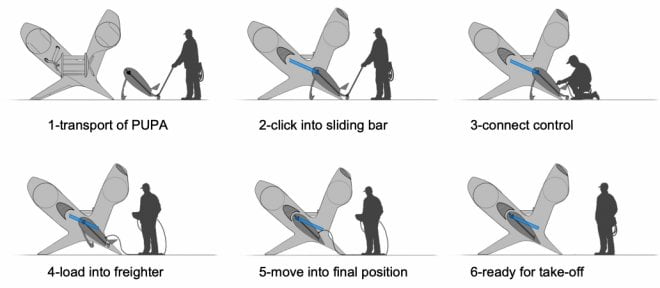
The PUPA is hooked into the cargo drone's hold using a special metal rod. Inside the compartment, the wheels fold like the trolley of an aircraft (or that of an ambulance stretcher). The payload of CCY-01 is 45 kg, the flight range is up to 40 km, the speed is about 130 km/h, the size of the landing area is 2,7 x 2,5 m .


